
Overview
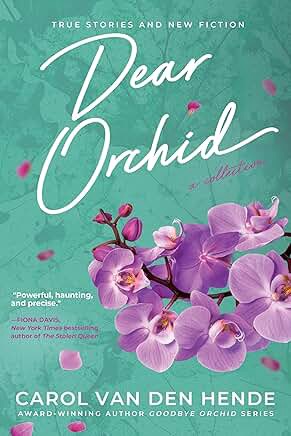
Powerful, haunting, and precise.” —Fiona Davis, New York Times bestselling author of The Stolen Queen
These aren’t just stories. They’re love letters.
Told through a mix of true stories and new fiction, Dear Orchid opens the heart in unexpected ways: through loss and love, silence and recovery, and the hard-won resilience of people who don’t always fit the mold.
With tenderness and heart, Dear Orchid is an Asian American author’s homage to Mary-Louise Parker’s Dear Mr. You, through letters to a girl newly freed from East Berlin, an aunt lost to Communist-era borders, and Purple Heart-decorated heroes. These intimate portraits explore the messy beauty of friendship, family, disability, and belonging.
You’ll meet a wounded hero who jokes through his pain, a beloved cat with a crayon note taped to his back (“HELP ME”), and characters who refuse to be defined by what they’ve lost.
The final chapter brings a fictional reunion with the unforgettable cast from the Goodbye Orchid trilogy, offering healing, closure, and a second chance romance.
Written in a lyrical, letter-style format, this collection blends memoir and imagination in a deeply personal exploration of grief, identity, and human connection. It’s a window into private moments that echo something universal.
Underneath the heartbreak and humor runs the quiet pull between star-crossed lovers, whose stories unfold across time, distance, and impossible odds.
Whether you’re drawn to true stories of survival or fictional narratives filled with tenderness and truth, Dear Orchidoffers an emotional journey that celebrates love in all its forms.
A collection for anyone who’s ever loved, lost, or longed to understand the emotional truth behind the quiet moments that shape us.
Includes elements of multicultural and medical romance, true stories, and unforgettable moments of vulnerability and hope.
Excerpt
Was it a hand-me-down? Had you found it in a thrift bin? You boarded my New Jersey Transit train wearing khaki pants, loafers, and a decidedly unfashionable oatmeal-blue sweater. Scratchy wool hairs sprouted from its worn surface, its V-neck revealing a button-down shirt underneath. But you also sported a warm smile and a pile of books, not a common accoutrement at eleven p.m. on a Saturday night.
So, when you indicated with a nod that you wanted to join my row of three orange seats, I scooted towards the window, leaving an empty space between us. In that moment regarding you, I instantly absorbed an array of impressions. You seemed genuine, trustworthy, warm, and—I don’t know how else to put it—safe.
That night, your literary choice made all the difference.
“Is that John Irving’s new book?” I asked, my tone trending towards excitement as I eyed the patterned grey cover printed with the words A Prayer for Owen Meany.
“Yeah, he spoke at my sister’s college graduation, so I wanted to read it,” you said, your voice new to my ears. Yet you seemed familiar to me, like we’d known each other a long time already.
As the train swayed, you spoke over the clatter of the tracks to tell me about the book and your work as an engineer. You made me chuckle, acting out scenes from the British comedy troupe Monty Python. “It’s just a flesh wound,” you cried, mimicking the tone of the Black Knight after King Arthur dealt a blow that was clearly more than a nick. I always said if there was one quality I needed in a person it was a sense of humor.
In most ways, you weren’t like other men I was drawn to. In those young college days, I tended towards creatives, artists, an edgy style, and a hint of angst. Still, I was disappointe to hear that you’d be getting off at the next stop to change trains.
Then your big brown eyes lit with an idea. “At night, I work at Brentano’s Bookstore to help pay down my student loans. Just give me
your address and I’ll ship you a copy of John Irving’s book.” The train slowed to enter your station.
You were a stranger. Yet your demeanor seemed kind. I calculated a split-second judgment call. I took the pen you offered and scribbled an address into your notebook. Not my actual physical address, but a safe, central location for mail.
You studied my college P.O. Box address and granted me a smile.
“Bye,” you said.
I waved as you left.
It wasn’t goodbye.
A week later, I visited my post office to find a brown paper-wrapped book. Using your return address, I sent a thank you card. Then you wrote me a letter telling me about yourself. You mentioned your parents’ impending divorce. I replied, telling you about my life at school and expressing sympathy for the hard time you must be going through. A few letters later, you wrote to ask me for my phone number.
We spent hours talking, trading stories both heartfelt and funny. One day, you suggested that we meet for dinner.
On our first date, our clashing sartorial choices almost ended our evening prematurely. Your conservative 3-piece blue suit seemed to promise a professorial lecture rather than a fun-filled meal. You later admitted that my outfit gave you pause. My minidress nipped at the waist, black-and-white striped stockings, and shiny patent shoes with oversized bows seemed quirky.
Luckily, those first impressions soon melted away. Once we sat down for dinner, it felt as though there wasn’t enough time for all we wanted to say and do. We prolonged the evening by imbibing drinks at my friend’s bar, laughing and talking all the while. Then we rode the train to New Brunswick to dance at my favorite college hang-out, The
Melody, until its two-a.m. closing time.
When did you sense this wouldn’t be the last time we saw each other?
***
Our early correspondence now lives together with keepsakes from our travels, alongside handmade pottery from our international assignment to China, our twin’s grade school finger paintings, and marble tiles from our two-year home renovation. On a treasured bookshelf, two copies of A Prayer for Owen Meany have spent the decades of our marriage tucked side-by-side, like a long-time wedded couple.
Somewhere among the stuff we’ve collected over the years, if we dig deep enough, perhaps we could even find your scratchy wool oatmeal blue V-neck sweater. I no longer question your fashion choices. Your favorite “uniform” of a sky-blue button-down shirt, khaki pants, and loafers suits you. As does your kindness, care, and always, your good humor. Thank you, dear Mr. Blue Sweater, thank you for our laughter and our own stories. Enough to fill books, our hearts, and a lifetime of memories.
About the Author:

http://www.carolvandenhende.com
@carolvandenhende
@c_vandenhende
@CarolVanDenHendeAuthor
CAROL VAN DEN HENDE is an award-winning novelist who pens stories of resilience and hope. Her novels Orchid Blooming, Goodbye, Orchid and Always Orchid draw from her Chinese American heritage, and have won 40+ literary awards, including the American Fiction Award, IAN Outstanding Fiction First Novel Award, and Royal Dragonfly Awards for Disability Awareness and Cultural Diversity. Buzzfeed, Parade, and Travel+Leisure named “heartwarming, heartbreaking” Goodbye, Orchid a most anticipated read. Glamour Magazine recommended this “modern, important take on the power of love.”Woman’s World called Always Orchid “One of 7 Books You Won’t Be Able to Put Down.” The International Pulpwood Queens selected Goodbye, Orchid, Orchid Blooming and Always Orchid as Books-of-the-Month. Carol’s mission is unlocking optimism as a writer, speaker, global marketer, digital strategist, Board Trustee and Climate Reality Leader. One secret to her good fortune? Her humorous husband and twins, who prove that love really does conquer all.


 reecaspieces